
Health Guidance for Travel and GYPC 2026
GYPC brings people together from many places and shared health practices matter. A few simple choices can help each of us arrive well, participate fully, and care for one another throughout the event.
Before You Travel
Take a moment to check how you are feeling.
- If you are experiencing fever, vomiting, diarrhea, a worsening cough, or other symptoms that may affect your travel or others around you, please seek medical advice before beginning your journey.
- Pack any needed prescription medications in your carry-on luggage and bring enough for your full trip, plus a little extra in case of travel delays. It is also wise to bring basic personal health supplies such as hand sanitizer, tissues, masks if you choose to use them, over-the-counter medications you commonly rely on, and a copy of important medical information.
- Travel can be tiring. Hydration, sleep, regular meals, and giving yourself time to adjust after arrival are not luxuries. They are part of helping your body be ready for the work, worship, and community of GYPC.
Simple Practices That Help Everyone
While traveling and during the event, help reduce the spread of illness by practicing good everyday hygiene:
- Wash your hands regularly with soap and water, especially before and after eating, after using the restroom, after using public transportation, and after coughing or sneezing.
- When soap and water are not available, use alcohol-based hand sanitizer. Regular hand cleaning with soap and water or hand sanitizer helps reduce the spread of infections including colds, flu, norovirus, and COVID variants.
- Cover coughs and sneezes with a tissue or your elbow, not your hands. Dispose of tissues promptly and clean your hands afterward.
- Be attentive to physical space. Much of our gathering time will take place in hotel ballrooms and meetings rooms with “theater-style” seating. If you are not feeling well, give others extra room, avoid close contact when possible, and finds ways to be present, while providing space from crowded settings.
- If you become ill during GYPC, you are encouraged to self-isolate using your hotel room. Ensure a chaperone or traveling partner is aware.
Masks
Masks are welcome at GYPC for anyone who chooses to wear one. Some participants may wear masks because of personal health concerns, recent illness, travel exposure, family considerations, or simply because it helps them feel more comfortable in crowded spaces.
Please respect one another’s choices. No one should be pressured to explain why they are or are not wearing a mask. Caring for one another includes allowing people to make thoughtful health decisions without judgment.
COVID and Other Respiratory Illnesses
COVID variants and other respiratory illnesses remain present, and you will cross paths with many travelers during your journey. If you develop symptoms such as fever, cough, sore throat, shortness of breath, congestion, body aches, chills, or unusual fatigue, please take those symptoms seriously.
- Ireland’s Health Service Executive advises people with COVID-19 symptoms who feel unwell to stay home until 48 hours after symptoms are mostly or fully gone and to avoid contact with others, especially people at higher risk from COVID-19.
- COVID tests are available at local pharmacies. If you test positive for COVID-19, isolate in your hotel room, inform event staff, ensure a chaperone or travel partner is informed, and determine how that positive test may affect travel plans.
For GYPC, if you feel sick at all during the event, avoid gathering closely with others, wear a mask, rest as much as you can, and seek medical guidance when needed. The most faithful choice may be missing in-person time and watching the livestream from your own space, so that you and others can participate more safely in the days that follow.
Medical Care in Dublin
GYPC does not provide medical services. Event staff and volunteers are not able to diagnose illness, provide treatment, distribute medication, or serve as medical professionals.
- If you need medical care while in Dublin, use local health services. Tourists in Dublin can access healthcare through General Practitioner (GP) clinics, private walk-in centers, or pharmacies for minor ailments. Non-EU/EEA visitors pay standard out-of-pocket fees.
- Ask the front desk of your hotel for the easiest to access walk-in healthcare available.
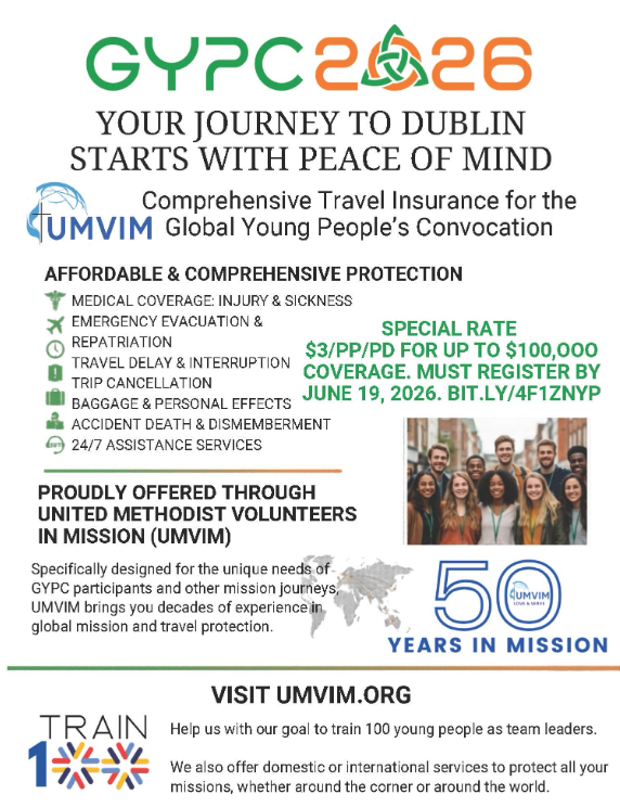
- If you have health insurance or travel health insurance, review those policies before you travel so you know your benefits. If you do not have travel insurance, consider purchasing a short-term policy from United Methodist Volunteers in Mission (UMVIM). Information for how to sign up for those policies are located at the bottom of this post.
- For a serious illness, serious injury, or life-threatening emergency, call 112 or 999 from any phone. Both numbers are free, and 112 works throughout the European Union.
- For minor illness or health questions, a local pharmacist may also be able to offer guidance.
A Word About Ebola
Some participants may have seen news about the current Ebola outbreak.
- Irish public health officials are monitoring the situation in coordination with international health authorities. As of the June 5, 2026, update from Ireland’s Health Protection Surveillance Centre, the outbreak is affecting the Democratic Republic of the Congo and Uganda.
- The HPSC reports that the European Centre for Disease Prevention and Control has assessed the risk to Europe as very low and that the current risk to Ireland is very low.
- Ebola does not spread the same way as flu or COVID-19. Ebola spreads through contact with body fluids of a person who is sick with or has died from Ebola, and that a person is contagious only once symptoms begin. Ebola does not spread through the air or from simply being near someone in public.
- For travelers coming from areas affected, take extra precautions as you prepare for travel. If you have symptoms of Ebola, take precaution and visit medical services for diagnosis. Do not travel if you are experiencing symptoms, this means if you have Ebola, you are contagious.
- For travelers coming from unaffected Ebola areas, research precautions and preventative measures. Take the steps you consider important to maintain your health and the health of others.
- GYPC leadership will continue to monitor public health guidance. We ask all participants to avoid rumors, stigma, or assumptions about people based on where they are from or where they have traveled. Our response should be grounded in accurate information, prayerful care, and mutual responsibility.
Caring for One Another
Shared health practices are simply one of the ways we practice love of neighbor. When we wash our hands, cover a cough, give someone space, stay back when we feel unwell, or respect someone’s choice to wear a mask, we help create a sanctuary where more people can participate with confidence and care.
Thank you for doing your part to help GYPC 2026 be a healthy, welcoming, and grace-filled gathering. We look forward to being together in Dublin.